

By Curavya Home Care — Trinity Health Center | Vadodara
Quick Answer: For many stable conditions — dehydration, certain infections needing IV antibiotics, nutritional support, or post-illness recovery — home IV therapy delivered by a trained nurse under physician supervision is just as safe and effective as a hospital visit, with far less disruption, lower infection exposure risk, and significantly less cost and time. It isn't right for every situation — patients who are critically unstable or need continuous monitoring still belong in a hospital. Knowing which category you fall into is the real question, not "home vs. hospital" as a blanket choice.
Why This Question Comes Up So Often
A doctor prescribes IV fluids, antibiotics, or a nutritional infusion, and the instinctive next step for most families is: go to the hospital, sit in a day-care or OPD queue, get the drip, come home hours later. For some conditions, that's genuinely necessary. But for a large share of routine IV therapy — the kind prescribed for dehydration, mild-to-moderate infections, post-surgical antibiotic courses, or nutritional support — the hospital visit adds cost, time, and exposure risk without adding anything the treatment actually needs.
Home IV therapy exists to fill exactly that gap: the same medically supervised treatment, delivered where the patient already is.
What Home IV Therapy Actually Involves
A qualified nurse, working under a physician-approved protocol, visits the patient's home with sterile equipment to administer:
- IV fluids for dehydration from illness, heat, or reduced oral intake
- IV antibiotics for infections that need intravenous rather than oral dosing
- Nutritional infusions for patients unable to eat adequately
- Vitamin and electrolyte drips as prescribed for deficiency correction
- Post-surgical or post-hospitalization IV courses continuing treatment started in hospital
Every session follows the same clinical protocols used in a hospital setting — sterile technique, correct dosing, monitoring for reactions — with the physician who prescribed the treatment staying informed of progress.
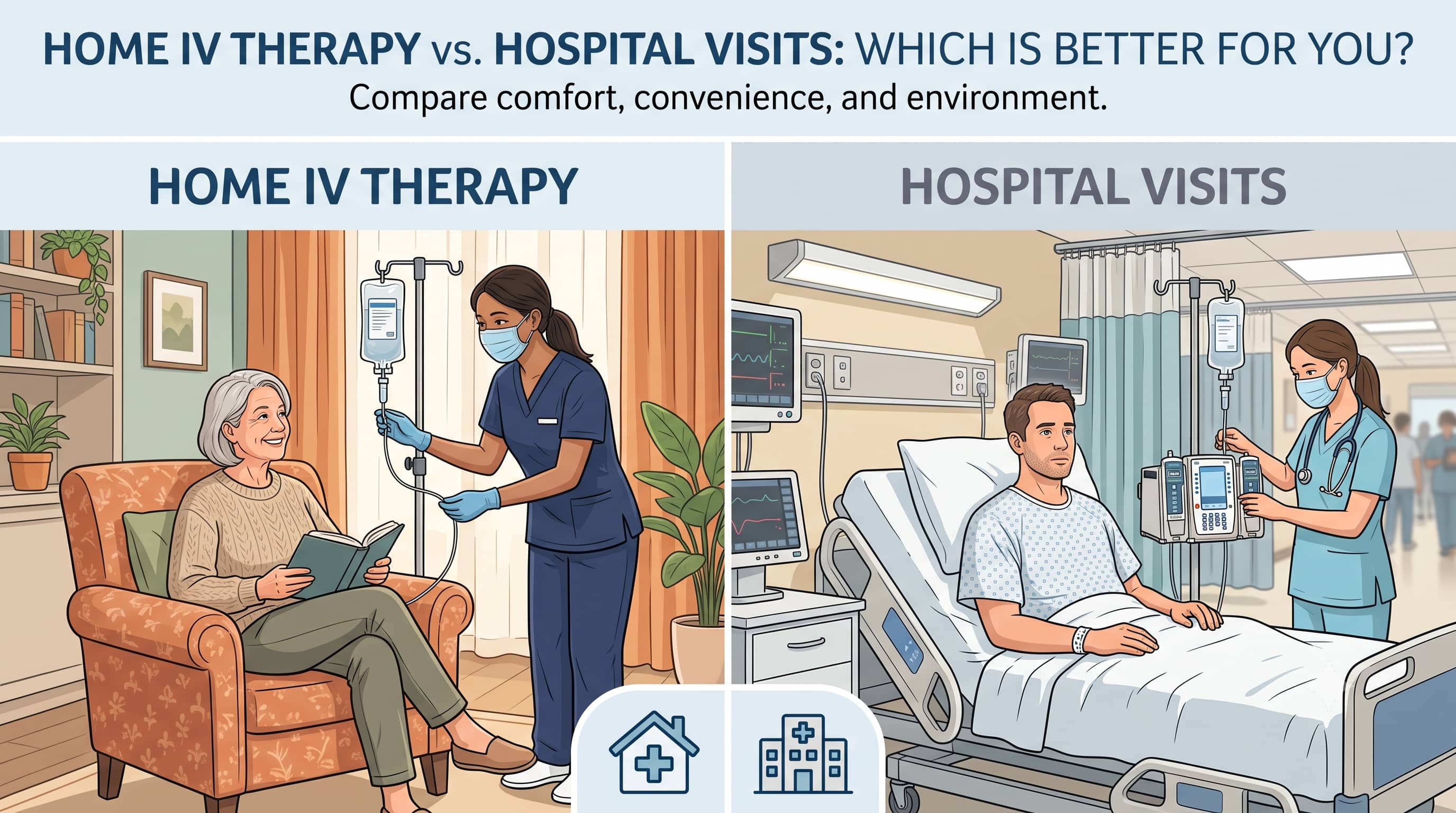
Home IV Therapy vs. Hospital Visit: Side by Side
| Factor | Home IV Therapy | Hospital Visit |
|---|---|---|
| Comfort | Patient stays in familiar surroundings | Unfamiliar environment, often stressful for elderly or anxious patients |
| Time cost | Nurse comes to you; no travel or waiting room | Travel, registration, and OPD/day-care wait times add hours |
| Infection exposure | Minimal — no exposure to other sick patients | Higher — hospitals concentrate sick patients in shared spaces |
| Cost | Often lower — no facility or bed charges | Facility charges, day-care fees, sometimes admission costs |
| Suitable for | Stable patients needing routine IV treatment | Unstable patients needing continuous monitoring or emergency care |
| Physician involvement | Prescribing physician oversees remotely, nurse executes on-site | Physician and hospital staff directly present |
| Best for | Dehydration, IV antibiotics, nutrition support, post-op continuation | Critical illness, unpredictable reactions, complex monitoring needs |
Is Home IV Therapy Actually Safe?
This is the question every family asks first, and it's a fair one. The honest answer: safety depends far less on the location and far more on who's administering it and how the case was selected.
Done correctly, home IV therapy is safe because:
- The nurse is trained and equipped with the same sterile technique, insertion protocols, and monitoring standards used in a hospital
- Only appropriate cases are selected for home treatment — a physician reviews the patient's condition first and rules out home therapy for anyone unstable or at risk of complications needing immediate intervention
- A clear escalation plan exists — if a reaction or complication occurs, there's a defined protocol to get the patient to appropriate care quickly
- The prescribing physician stays informed throughout the course, not just at the start
What makes it unsafe is skipping any of these — an unsupervised or informally arranged IV drip without physician oversight is a genuinely different thing from a structured, physician-led home IV program.
When Home IV Therapy Is the Right Choice
- Dehydration from viral illness, heat exhaustion, or reduced oral intake, in an otherwise stable patient
- IV antibiotic courses for infections where oral antibiotics aren't suitable, but the patient doesn't need hospital-level monitoring
- Post-surgical recovery, continuing an IV course that began in hospital once the patient is stable enough to go home
- Nutritional support for patients with poor oral intake due to illness, age, or recovery
- Elderly or mobility-limited patients for whom a hospital trip is physically taxing and medically unnecessary
- Chronic condition management requiring periodic infusions where the patient is otherwise stable
When a Hospital Visit Is Still the Right Call
Home IV therapy is not a substitute for hospital care when:
- The patient is hemodynamically unstable or showing signs of clinical deterioration
- Continuous monitoring (cardiac, oxygen, or otherwise) is medically necessary
- There's meaningful risk of a severe allergic or adverse drug reaction requiring immediate advanced intervention
- The underlying condition itself needs hospital-level diagnostic workup, not just the IV treatment
- It's a genuine emergency
A good home care provider will tell you plainly when your case belongs in a hospital rather than trying to keep every case at home — that's a sign of a program that's actually being run responsibly.
Cost and Time: The Practical Difference
Beyond clinical considerations, the practical case for home IV therapy is significant for eligible patients:
- No facility or bed charges that hospitals typically add on top of the treatment itself
- No travel time, which matters especially for elderly patients or families juggling work and childcare
- No waiting room time — a hospital IV session that takes 45 minutes of actual treatment can easily become a 3-hour outing once travel, registration, and waiting are added
- Reduced exposure risk to other illnesses circulating in a hospital or clinic environment, which matters more for immunocompromised or elderly patients
What to Look For in a Home IV Therapy Provider
- Physician-led protocols, not just a nurse arriving with a prescription and no clinical oversight
- Trained, verified nursing staff with documented IV administration experience
- Proper case screening before agreeing to treat at home — providers who accept every case without assessment are a red flag
- A clear emergency escalation plan, communicated before treatment starts
- Transparent pricing, with no ambiguity about what's included
Curavya's Home IV Therapy in Vadodara
Curavya — Trinity Health Center's physician-led home care initiative — offers home IV therapy for eligible patients across Vadodara, including Bhayli, Alkapuri, Gotri, Vasna-Bhayli Road, and Manjalpur. Every case is reviewed by Dr. Dhruvil Patel or a senior consultant before treatment begins, IV fluids and infusions are administered by trained nursing staff following hospital-grade sterile protocols, and a clear escalation plan is in place from the first visit.
If you've been prescribed IV fluids, antibiotics, or a nutritional infusion and want to know whether home treatment is right for your case, our team can assess that before you commit to either option.
📞 Call or WhatsApp: +91 6355773042
🌐 Book a consultation: curavya.rsappz.com
Frequently Asked Questions
Is home IV therapy more expensive than a hospital visit?
Usually the opposite — home IV therapy typically avoids facility and bed charges that hospitals add on top of the treatment itself, though exact costs depend on the specific treatment and duration.
Can elderly patients safely receive IV therapy at home?
Yes, and in many cases it's actually preferable — avoiding the physical strain of a hospital trip and reducing exposure to hospital-acquired infections, provided the patient's condition is stable and has been assessed by a physician first.
What happens if there's a reaction during home IV therapy?
A properly run home IV program has a defined escalation protocol — the attending nurse is trained to recognize reactions early, and there's a clear plan to get the patient to appropriate emergency care quickly if needed.
How is the treatment prescribed and monitored?
A physician reviews the patient's condition and prescribes the specific IV treatment; the home care nurse administers it following that protocol, with the physician kept informed of progress throughout the course.
Can I switch from home therapy to hospital care if needed?
Yes — a responsible home care provider builds this into the plan from the outset rather than treating home care as a fixed, one-way decision.
Key Takeaways
- Home IV therapy is a safe, medically supervised alternative to hospital visits for stable patients needing routine IV treatment — not a shortcut around proper care.
- It typically costs less, takes far less time, and reduces exposure to hospital-acquired infections.
- It is not appropriate for unstable patients or those needing continuous monitoring — those cases still belong in a hospital.
- The safety of home IV therapy depends on physician oversight, trained nursing staff, proper case selection, and a clear emergency escalation plan.
This article is for general awareness only and is not a substitute for professional medical advice. Whether home IV therapy is appropriate depends on your specific condition — please consult a physician. For home IV therapy in Vadodara, contact Curavya at +91 6355773042.