

By Curavya Home Care — Trinity Health Center | Vadodara
Quick Answer: Supervised elderly home care means a trained nurse or caregiver manages daily needs — vitals, medication, mobility, hygiene — while a physician oversees the overall care plan and steps in when something changes. It combines the comfort of staying at home with the safety net of clinical oversight, which is what separates it from a general helper or unsupervised attendant. In Vadodara, Curavya — Trinity Health Center's home care initiative — provides exactly this model, led by Dr. Dhruvil Patel and a trained care team.
Why "Just a Caretaker" Isn't Always Enough
As parents and grandparents age, most families reach the same point: someone needs to be around more often, but a hospital or assisted-living move feels premature — or the person themselves simply doesn't want to leave home. The usual first step is hiring a caretaker or attendant. That helps with the day-to-day, but it leaves a real gap: an attendant can remind someone to take a pill, but they can't tell you whether a blood pressure reading is a one-off blip or the start of something that needs a doctor's attention.
That gap is exactly what medically supervised home care is built to close. It's not a replacement for a caretaker — it's a caretaker plus a clinical layer above them, so changes in an elderly person's condition get caught and acted on early, not after a crisis lands them in an emergency room.
What Medically Supervised Elderly Care Actually Includes
Daily Clinical Monitoring
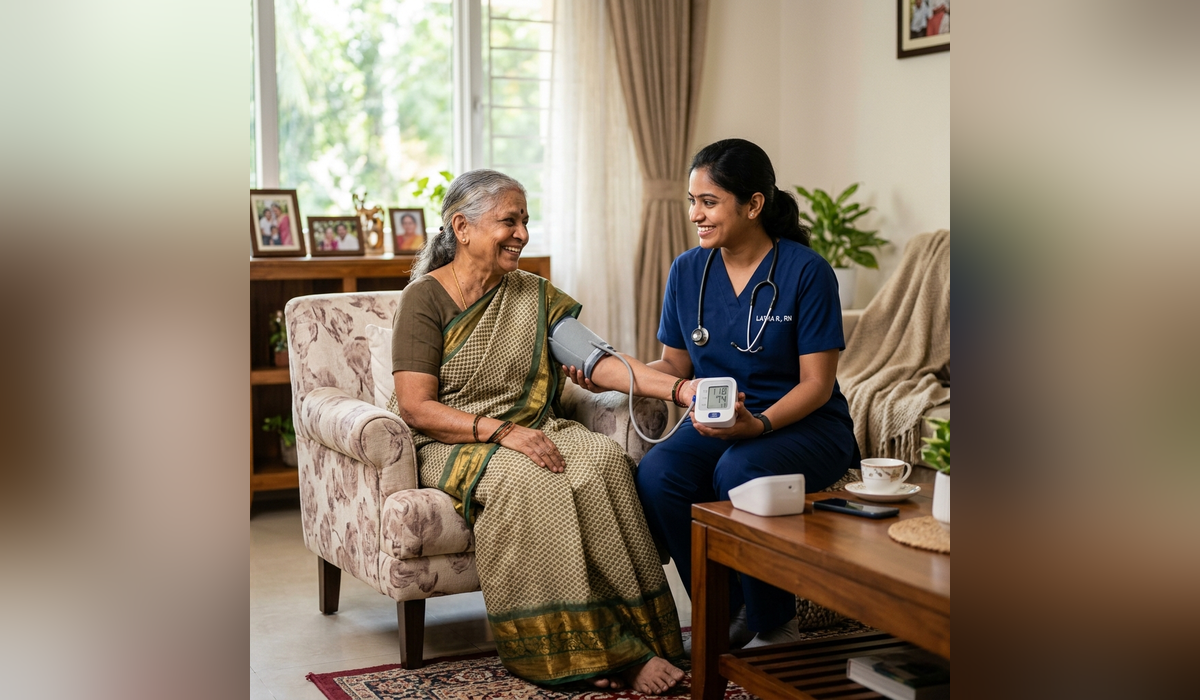
Trained nursing staff track vitals — blood pressure, blood sugar, oxygen saturation, temperature — on a set schedule, not just when something seems wrong. Trends matter more than single readings, and a nurse trained to read those trends can flag a problem days before it becomes visible to family members.
Medication Management
Elderly patients are often on five or more medications for different conditions — a genuine risk for missed doses, duplicate doses, or drug interactions. Supervised care includes a structured medication schedule, adherence tracking, and periodic review by the supervising physician to catch conflicts or unnecessary prescriptions.
Physician Oversight
This is the core difference from a standard attendant service. A doctor formulates and periodically reviews the care plan, is available for escalation when the nursing team flags a concern, and can adjust the plan as the person's condition changes — without needing a clinic visit for every check-in.
Mobility and Fall Prevention
Falls are one of the leading causes of hospitalization in older adults. Supervised care includes assessing home mobility risks, assisting with safe movement, and building simple routines that reduce fall risk — bathroom safety, lighting, walking aids where needed.
Nutrition and Hydration Tracking
Appetite and thirst sensation both decline with age, quietly increasing the risk of malnutrition and dehydration. A trained caregiver tracks intake and flags patterns worth a physician's attention, rather than waiting for visible weight loss or a hospital-worthy dehydration episode.
Wound and Skin Care
For patients with limited mobility, pressure sores and skin breakdown are a real risk. Nursing staff trained in wound assessment catch early skin changes and manage dressing or care needs before a minor issue becomes a serious one.
Emergency Escalation Protocol
Perhaps the most important piece: a clear, pre-agreed plan for what happens if something goes wrong — who gets called, what the immediate response is, and how quickly a physician or emergency service gets involved. Families shouldn't have to figure this out in the moment.
Supervised Home Care vs. an Unsupervised Attendant
| Aspect | Unsupervised Attendant | Medically Supervised Care |
|---|---|---|
| Daily assistance (bathing, mobility, meals) | Yes | Yes |
| Vitals tracked and trended | Rarely | Yes, on a set schedule |
| Medication given | Reminders only | Managed, tracked, and reviewed |
| Clinical judgment on changes | None | Nurse-trained, physician-backed |
| Physician involvement | None | Ongoing oversight and plan review |
| Emergency response | Ad hoc | Pre-defined escalation protocol |
| Best suited for | Healthy, stable seniors needing company/help | Seniors with chronic conditions, recent hospitalization, or higher fall/health risk |
An unsupervised attendant works well for a generally healthy senior who mainly needs company and help around the house. Once chronic conditions, multiple medications, or a recent hospital discharge enter the picture, the clinical layer stops being optional.
Who Benefits Most From Supervised Care
- Seniors with chronic conditions — diabetes, hypertension, heart disease, or COPD, where daily monitoring catches problems before they escalate
- Post-hospitalization patients — especially after cardiac events, surgery, or a stroke, when the risk of complications or readmission is highest in the weeks right after discharge
- Seniors on multiple medications — where interaction risk and adherence tracking genuinely matter
- Those with mobility limitations — where fall risk and wound care need active management
- Families who live at a distance — supervised care gives peace of mind that isn't dependent on someone being physically present every day
- Anyone recovering from a fall or fracture — where mobility support and monitoring go hand in hand
What a Typical Supervised Care Plan Looks Like
- Initial physician assessment — Dr. Dhruvil Patel or a senior consultant evaluates the patient's health history, current conditions, and daily living needs
- Custom care plan — built around the specific conditions and risks identified, not a generic template
- Scheduled nursing visits — daily or as-needed vitals checks, medication administration, and hygiene assistance
- Regular physician review — the plan is reassessed periodically and adjusted as the patient's needs change
- 24/7 escalation access — a direct line to the care team for anything urgent, day or night
Common Questions Families Ask
Is this the same as hiring a nurse privately?
Not quite. A privately hired nurse may perform tasks well but typically works without physician oversight or a documented care plan. Supervised care ties the nursing work to an actual physician who reviews progress and can intervene clinically — the nurse isn't operating in isolation.
Does my parent need to be seriously ill to need this?
No. Many families start supervised care proactively — after a health scare, following a hospital discharge, or simply because a parent's condition has become complex enough that "checking in" isn't enough anymore. Starting before a crisis is usually easier than starting after one.
Can care be adjusted as needs change?
Yes — that's part of the point. A parent who initially needs occasional vitals checks may later need daily wound care or more intensive monitoring after a health event. Supervised care scales with the person, rather than locking a family into one fixed service.
What happens in a genuine emergency?
A defined escalation protocol means the nursing team knows exactly who to call and what steps to take immediately, and the supervising physician is looped in without delay — rather than a family scrambling to figure out next steps under pressure.
Curavya's Approach to Elderly Home Care in Vadodara
Curavya — Trinity Health Center's home care initiative — brings this exact model to families across Vadodara, including Bhayli, Vasna-Bhayli Road, Alkapuri, Gotri, and Manjalpur. Every elderly care plan is formulated and periodically reviewed by Dr. Dhruvil Patel and senior consultants, delivered through a trained, verified nursing team, with daily vitals tracking, medication supervision, and a 24/7 emergency escalation protocol built in from day one.
Whether it's ongoing support for a parent managing diabetes and hypertension, structured recovery care after a hospital stay, or simply the peace of mind of knowing a physician is watching over the plan, Curavya's long-term care program is built around one principle: home comfort shouldn't mean a drop in clinical standards.
📞 Call or WhatsApp: +91 6355773042
🌐 Book a consultation: curavya.rsappz.com
Key Takeaways
- Medically supervised elderly care combines daily hands-on support with physician oversight — something a standard attendant service doesn't provide.
- It matters most for seniors with chronic conditions, multiple medications, recent hospitalizations, or mobility risks.
- A proper care plan includes vitals tracking, medication management, mobility support, nutrition monitoring, and a clear emergency escalation protocol.
- Starting supervised care proactively, before a health crisis, is usually easier on both the patient and the family than starting reactively.
This article is for general awareness only and is not a substitute for professional medical advice. Please consult a physician to determine the right level of care for your family member. For elderly home care in Vadodara, contact Curavya at +91 6355773042.