

By Curavya Home Care — Trinity Health Center | Vadodara
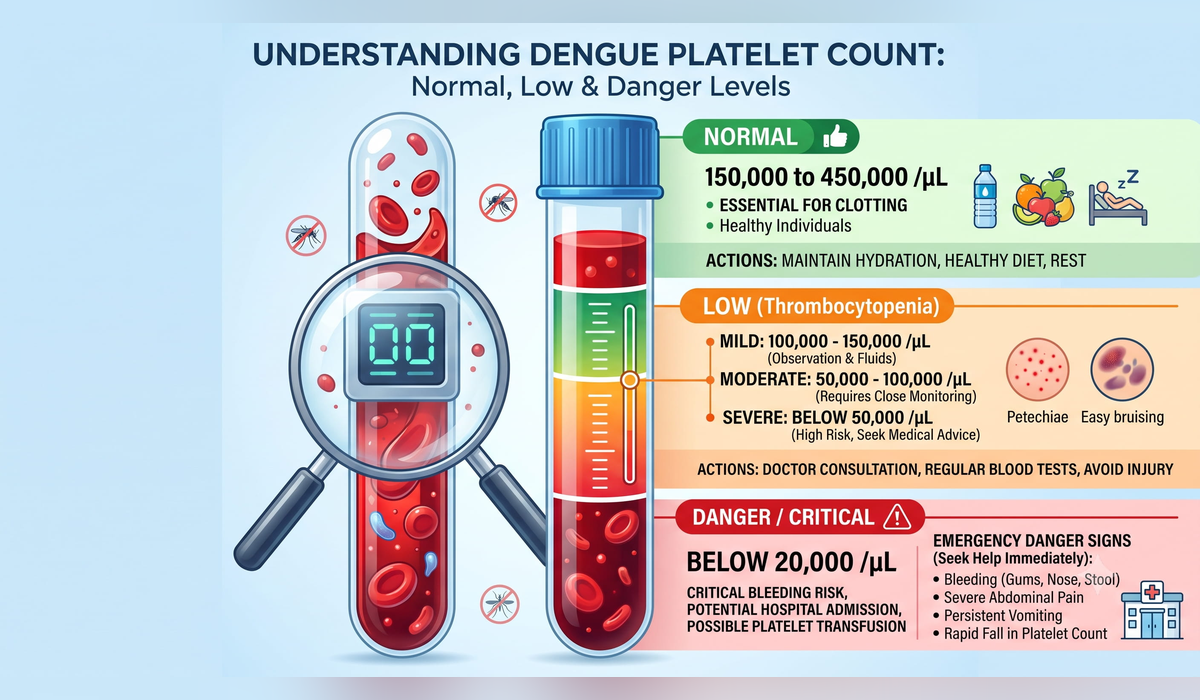
Quick Answer: A healthy platelet count sits between 150,000 and 450,000 per microlitre (µL) of blood. During dengue, this can fall sharply — a count under 100,000/µL is considered low, and under 20,000/µL is critical and needs close medical supervision. Platelet count alone never tells the full story; it should always be read together with your symptoms and a physician's assessment. Book a home doctor visit if you or a family member has fever during dengue season.
Why This Number Worries Every Household in Vadodara
Every year, as the monsoon eases and stagnant water collects across Vadodara — from Bhayli to Alkapuri to Gotri — dengue cases climb. And almost every family that's been through it remembers the same moment: the lab report comes back, someone reads the platelet number out loud, and panic sets in.
The truth is a little less alarming than the WhatsApp forwards suggest. A dropping platelet count is expected in dengue — it's part of how the illness runs its course. What actually matters is how far it drops, how fast, and whether it comes with warning signs like bleeding, severe pain, or persistent vomiting. Doctors weigh all of that together; they don't treat the number in isolation.
This guide walks through what platelets do, why dengue affects them, a day-by-day pattern of what to expect, and when it's genuinely time to get tested or seek medical care.
What Are Platelets, and What Do They Do?
Platelets are small fragments made in your bone marrow whose main job is clotting — when a blood vessel is damaged, they gather at the site and form a plug to stop bleeding. They live for only about a week to ten days, so your body is constantly replacing them. Anything that interferes with that production line, or destroys platelets faster than they can be replaced, will bring the count down. A viral infection like dengue does both.
Why Dengue Lowers Platelet Count
There isn't one single cause — several things happen at once during a dengue infection:
- The bone marrow slows down. While the virus is active, marrow output of new platelets temporarily drops.
- The immune system gets confused. Antibodies made to fight the virus sometimes mistakenly target platelets too, speeding up their destruction.
- Platelets get used up faster. The body consumes them more quickly while managing changes in blood vessels caused by the infection.
- Plasma can leak from vessels in severe cases. This thickens the remaining blood and can make the platelet count look even lower.
In short: the virus takes hold, the immune system reacts, marrow output drops while destruction speeds up, the count bottoms out roughly midway through the illness, and then — as the fever breaks and the body settles — production ramps back up and platelets recover over the following one to two weeks.
Platelet Count Reference Chart
| Platelet Count (per µL) | Level | Risk Level | What Usually Happens |
|---|---|---|---|
| 150,000 – 450,000 | Normal | Low | No specific concern; routine monitoring |
| 100,000 – 150,000 | Mildly low | Low–Moderate | Repeat testing every 1–2 days; watch symptoms |
| 50,000 – 100,000 | Moderately low | Moderate | Closer monitoring; doctor may order daily CBC |
| 20,000 – 50,000 | Severely low | High | Frequent checks; hospital evaluation often advised |
| Below 20,000 | Critical | Very high | Requires immediate medical attention |
Most people recover comfortably at the "Normal" and "Mildly low" stages with rest, fluids, and outpatient monitoring at home. As the count drops further, physicians start paying closer attention to bleeding tendency, hematocrit, and other clinical signs — the number itself isn't a treatment trigger on its own.
The Day-by-Day Pattern (Counting from First Day of Fever)
| Day | What Typically Happens |
|---|---|
| Day 1–2 | Fever starts; platelet count is often near-normal or only slightly reduced |
| Day 3 | Count may begin trending down |
| Day 4–5 | This is usually the phase doctors watch most closely — count often continues falling |
| Day 6 | Frequently the lowest point, though this varies person to person |
| Day 7 | Fever typically starts easing; count may begin to stabilise |
| Day 8 onward | Recovery phase — bone marrow ramps up again, count climbs back over 1–2 weeks |
Because the low point usually falls between days 4 and 6, doctors often ask for a repeat CBC during this window — especially if fever hasn't broken or new symptoms show up.
When Does a Low Count Become Dangerous?
There's no single magic number that applies to everyone, but as a general guide:
- ~50,000/µL — bleeding risk starts rising with minor injury
- ~30,000/µL — doctors typically want closer follow-up
- ~20,000/µL — spontaneous bleeding (gums, nosebleeds) becomes a realistic concern
- ~10,000/µL — bleeding risk increases further; often needs hospital-based monitoring
- Below 10,000/µL — considered critical, requiring immediate medical management
Warning Signs to Watch For
Seek medical attention right away if you notice:
- Unexplained bruising or purple skin patches
- Bleeding gums or nosebleeds
- Blood in urine or dark, tarry stools
- Vomiting blood or coffee-ground-coloured material
- Tiny red or purple spots on the skin (petechiae)
- Persistent stomach pain
- Unusual tiredness, restlessness, or trouble staying alert
- Cold, clammy skin or sudden low energy
When Should You Get Tested?
Consider a CBC or platelet count test if you notice:
- Sudden high fever during dengue season
- Severe body ache, joint pain, or pain behind the eyes
- A skin rash appearing a few days into the fever
- A positive NS1 antigen or dengue IgM result
- You're already recovering from confirmed dengue and need follow-up monitoring
- A child with fever and reduced appetite or activity
- An older adult with fever, who may need closer observation due to other health conditions
- A pregnant woman with fever — this needs both obstetric and infectious-disease input
Curavya's home phlebotomy team can collect your sample for a CBC, platelet count, or dengue NS1/IgM test directly from your home anywhere in Vadodara, with a physician reviewing the results.
Platelet Count Isn't the Whole Picture
A common misunderstanding is that the platelet number alone decides how serious a dengue case is. In reality, doctors weigh it alongside:
- Hematocrit trends — a rising hematocrit can signal plasma leakage, often more significant than the platelet number alone
- Full CBC picture — white cell trends add useful context
- Symptoms — ongoing vomiting, abdominal pain, or bleeding signs often matter more than the lab value
- Hydration status — fluid intake meaningfully affects how the illness progresses
- Official warning-sign criteria — doctors use these to decide when closer monitoring or hospital care is needed
Common Myths, Corrected
| Myth | Reality |
|---|---|
| Papaya leaf extract cures low platelets | Not established as proven treatment; shouldn't replace medical monitoring |
| Goat's milk raises platelets quickly | No reliable clinical evidence for this |
| Every low count needs a transfusion | Transfusion decisions depend on bleeding risk, not the number alone |
| You must stop all medicines once platelets drop | Usually only aspirin/NSAIDs (which affect clotting) are avoided — other medicines are managed per your doctor's advice |
| Platelet count is the only thing that matters | Hydration, hematocrit, and warning signs matter just as much |
| A normal platelet count rules out dengue | Not true — counts can stay normal in early infection; NS1/IgM testing helps confirm |
Supporting Recovery at Home
Recovery mainly depends on how your bone marrow responds, but these habits help:
- Drink plenty of water, ORS, or clear fluids
- Eat adequate protein to support tissue repair
- Include fruits and vegetables for general nutrition
- Rest — your body directs more energy toward healing
- Keep up with follow-up testing so your doctor can track progress
Avoid relying on unproven home remedies in place of medical monitoring.
When Is a Platelet Transfusion Actually Needed?
Current medical practice generally doesn't recommend transfusion based on the number alone. Physicians typically consider it only when there's active bleeding or a significant bleeding risk alongside other clinical findings — not simply because a report shows a low count. This decision always rests with your treating physician, based on your complete clinical picture.
Get Tested at Home with Curavya
If you or someone in your family has fever during dengue season, don't wait to find out where things stand. Curavya — Trinity Health Center's physician-led home care service — can send a trained phlebotomist to your home anywhere in Vadodara for:
- CBC (Complete Blood Count)
- Platelet Count Test
- Dengue NS1 Antigen / IgM Test
Every result is reviewed by our physician team, with digital reports and clear next steps — no need to sit in a crowded clinic waiting room while unwell.
📞 Call or WhatsApp: +91 6355773042
🌐 Book online: curavya.rsappz.com
Frequently Asked Questions
What is the normal platelet count?
Between 150,000 and 450,000 per microlitre of blood.
What counts as a low platelet level?
Under 150,000/µL is generally considered low, though the degree of drop and clinical picture matter more than the number alone.
Will my platelet count return to normal?
Yes — for most dengue patients, the count recovers on its own within one to two weeks once the acute infection passes.
When should platelets be tested during dengue?
Often every 24–48 hours, especially during the critical days 4–6 of fever.
Does a low count always mean something is wrong?
Not necessarily. Moderate drops aren't automatically dangerous — risk depends on how fast the count is falling and whether bleeding symptoms are present.
What foods help platelet recovery?
A balanced diet with adequate protein, fruits, vegetables, and fluids supports recovery generally — no single food has been shown to rapidly raise platelet counts.
On which day does the platelet count usually drop the most?
Commonly around days 4–6 of fever, though this varies by person.
Can you have dengue with a normal platelet count?
Yes, especially early in the infection — NS1 antigen testing can detect dengue before the count drops.
Is a transfusion always required in dengue?
No. It's generally considered only for active or significant bleeding risk, not for a low number by itself.
Can children have more severe drops?
Yes, and because symptoms can be harder to recognise early in children, closer monitoring by a pediatrician is advised.
This article is for general awareness only and is not a substitute for professional medical advice. Please consult a physician for diagnosis and treatment decisions. For a home consultation or test in Vadodara, contact Curavya at +91 6355773042.